Wednesday, May 18, 2011

Istanbul to Izmir

Sorry for the delay in getting this latest post out. I've been busy with other endeavors and have lost a little momentum here in the blogosphere. I promise to be more diligent and not let so much time elapse between postings from here on out.

After five short days in Istanbul it was time to head south. Let it be known that five days in Istanbul is not nearly enough. You could spend a month in Istanbul and not see all that you should. I will be going back before too long. 

So, on to Izmir....

The Wheels on the Bus Go 'round and 'round....

We got up early on Day Six in Istanbul and headed to the bus station. Now, if you've ever ridden a cross-country bus then you're probably thinking, "Oh boy, this is NOT gonna be good". I know that's what I was thinking. The furthest I ever rode a bus before was from Phoenix to San Diego one summer when my best friend and I drove over to Phoenix in his '54 Ford pick-up for a weekend because the drinking age in Arizona at that time was 19. After two nights of waaaaayyyy too much party time his truck decided it wasn't up to the return trip and quit on us. In Phoenix. In the middle of summer. Not good. So, we left the truck at his aunt's house and off to the Greyhound station we went. The bus was packed when we boarded and we were unable to find two seats together. I ended up sitting next to some little smelly dude who sucked on a pint bottle of whiskey for the first couple of hours on the road before he fell asleep/passed out and then he spent the rest of the trip snoring. And did I mention it was summertime? Hot, cramped and uncomfortable with a guy who looked like the Kickapoo Joy Juice Indian from L'il Abner sitting next to me doing his best imitation of a chainsaw (and reeking) throughout the night. Not a pleasant memory. So, as you can imagine, it was with a slight amount of trepidation I prepared to take a nine-hour bus ride through the Turkish countryside. 

Once again, I couldn't have been more pleasantly surprised. The bus was exceedingly comfortable with plush, roomy seats, television (which did me no good as I do not speak Turkish) and an attendant who spent the entire trip seeing to our every need. Food, drinks (hot and cold), candy. All included in the price of the ticket. All in all, I highly recommend taking the bus if you're ever going that way because the roads are excellent, the ride is pleasant and it's a great way to get a look at the countryside. 

Check it out. 

Here is a picture of the bus taken at the rest stop about halfway through the trip. 

You can see that the rest stop is new and had a restaurant and, much to my chagrin, the ubiquitous rest stop Starbucks. Ah, good 'ol western style expansionism.

It was a beautiful day (finally) and the scenery all the way down was great. We passed through many small towns, but mostly it was wide open countryside. 


Here is our Rico Suave attendant. He spoke no English, so there wasn't a whole lot of conversation, but he was a pleasant enough chap. And damn good at his job. Very dapper too, I might add. On a freakin' BUS!! Take that, Greyhound!


All right. Now I'm just gonna drop a bunch of pictures I took from the bus on you. I can't name the towns or tell you anything about the towns. But I can show you what Turkey looks like between Istanbul and Izmir...

The stadium where Besiktas plays its home games. This is taken
on our way out of Istanbul.


More Istanbul


The Strait of Bosphorus.


The ferry ride across the Sea of Marmara to Asia. You can see the bus on
the right under the bridge. 


Another castle/fort. They're everywhere over there.


Rico Suave feeding the seagulls. 


I'll tell you right now I hate seagulls. But these were really cool seagulls. They're about two-thirds the size of the gulls you see in San Diego and they have very pretty markings. These seagulls I don't hate. 
Bye-bye Europe. Looking out the back of the boat. 


This is right after we drove off the ferry near a town called Yalova.
That's about all your gonna get out of me for the rest of the trip down. 


Some kind of municipal building. One of the many smaller cities we
passed through on our way south. 


Mustafa Kemal Ataturk. The Father of the Turkish Republic.
There are images of him everywhere you go in Turkey.
Look him up. 


Now we're getting into the wide open. You can see the further south
we go the better the weather gets. 


Looking out the other side of the bus. 
Cousin Cheryl. 
An absolutely HUGE horse farm. It took us ten solid minutes to
drive past it. 

The gates to the horse farm. I tried to get a translation for this but was
unsuccessful. Let me know if you find anything out. 
Big houses on the big horse farm. 
The far side of the horse farm. I took 17 pictures from one side
to the other. Big freakin' horse farm. 
Countryside. 
A shepherd and his flock. 
Bare trees in the countryside. 
A hillside town. Too bad that damned sign is in the picture. 
Heading down into Izmir. Evening light on the hillsides. 
I have no idea.  
Izmir
Sundown in Izmir.
Well, that's it. We made it down in grand fashion. It was actually a very relaxing, comfortable trip. And now that I've shown you Istanbul, from here on out I'll be showing the sights of southwestern Turkey and the Aegean coast. 

Until next time...


The Bay of Izmir


Sunday, May 8, 2011

The End of Day Five in Istanbul; Day Two in Sultanahmet

Day five in Istanbul and day two in Sultanahmet are the same day. I realized after my, "Sultanahmet: Day One" post that I might be creating a little confusion for my readers. Still confused? Work it out.

One more thing...

As you probably came to realize after reading my last post, the Hagia Sofia was a bona fide brass-plated four-door mind blower. The most amazing "wrought by man" thing I have ever seen. The only time in my life I can remember being humbled to that degree by an inanimate object was when I spent a week riding a raft through the Grand Canyon thirty-some-odd years ago. This was a completely different thing.

The Grand Canyon is a "wrought by God" thing. After bobbing along the river that wends its way through the bowels of the earth at the bottom of that canyon for a couple of days, I came to realize that mankind in general, and Ado in particular, really don't amount to much on this big ol' rock we call earth. The time it took for water and gravity to carve out those amazing, colorful rock walls, one grain of sand at a time and create a canvas for setting and rising suns to splash with their light-filled palettes is so great as to be unfathomable by mortal men. A few million years from now humans will be long gone and long forgotten from this earth and that river and that canyon will be doing exactly what they're doing today. In a much shorter time span than that, I too will be long gone and long forgotten.

But the Hagia Sofia didn't make me ponder my place in the universe by overshadowing my meager lifespan. It shook me because, confronted by this manmade three-dimensional kaleidoscope of marble and mosaic the size of a battleship, it made me realize how little I had accomplished in my fifty-four rides around the sun. It made me realize what I might have done and reminded me of those things I have not done. It reminded me of the greatness man is capable of and of which I have fallen so short.

The Grand Canyon knocked the wind out of me with the realization that it exists effortlessly. It exists only because, inexorably through the millenia, it came to be. The Hagia Sofia exists only because 1,474 years ago men imposed their will on mortar and stone and brought it into this world. It exists only because men forced it into existence. Humbling, indeed.

The Great Palace Mosaic Museum

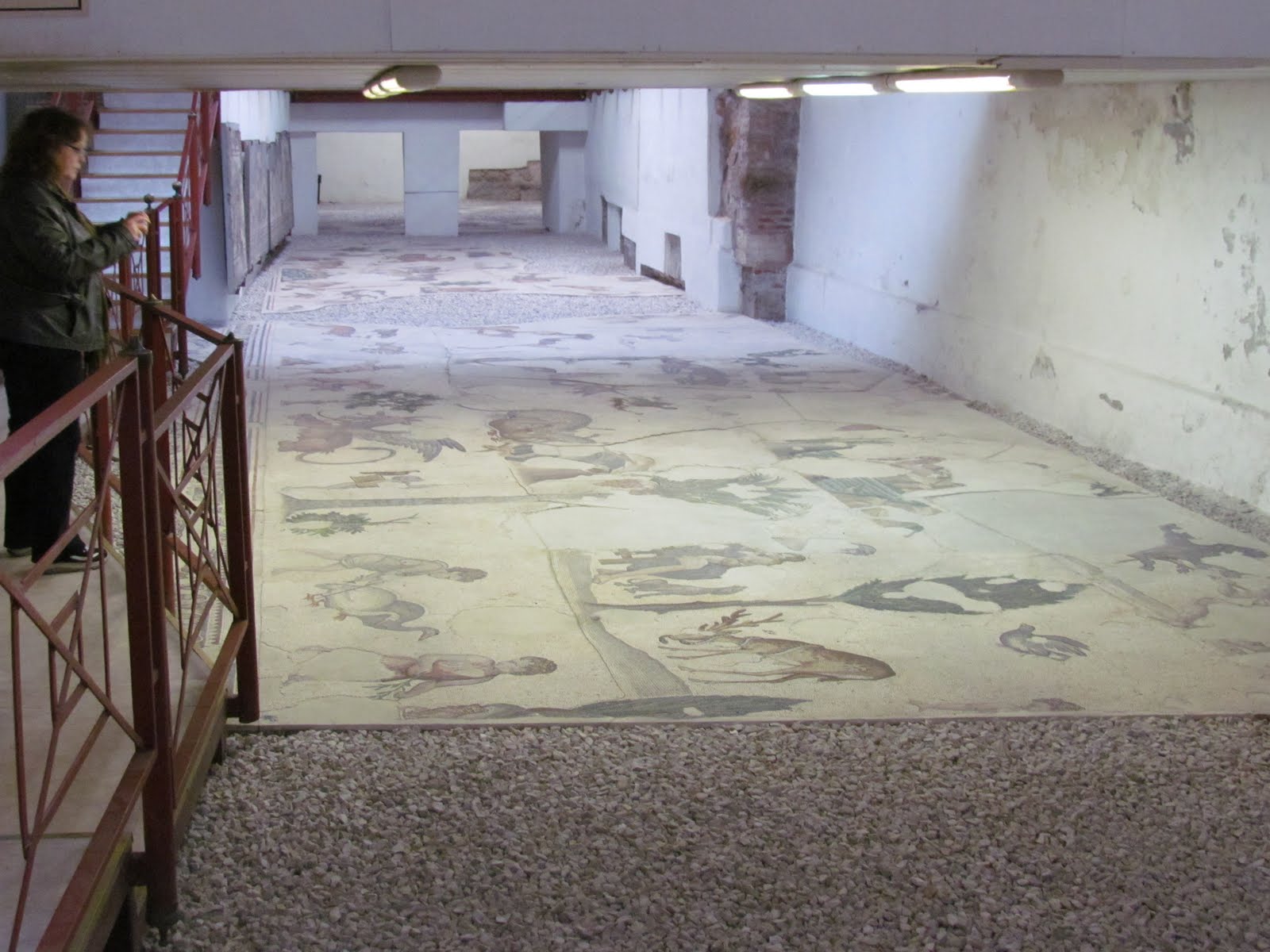
In 1935 a bunch of Scottish archaeologists were digging up some really old stuff in Sultanahmet at the spot where the Arasta Bazaar once stood. They discovered a mosaic covered walkway that was long ago part of the Great Palace of Constantinople. It was a section of a peristyle walkway from one of the palace courtyards and it covers approximately 2,000 square yards. It is ENTIRELY covered in mosaics depicting fantastic and everyday images of life in those times. The fact that people actually walked on these works of art is mind boggling. Art was part of everything they built back in those days and beauty always seemed integral to their plans. In these modern times we could learn a lesson or two from the ancients.

The mosaics are now uncovered and housed in the museum near Sultanahmet square. The museum is not very well know and while we were there it was empty except for me, my cousin Cheryl, my mother and the people who work there. There is a lot to see and the pace is whatever you want it to be. If you ever find yourself in the area, I highly recommend taking the time to see it. Check it out...

The largest contiguous section of walkway that is on display.
We'll call this the left section.
This would be the center section. 
And this would be the right section.


Many of the scenes depict a pastoral lifestyle. A vendor pushing a cart, animals being fed, trees bearing fruit.


Here are children at play.


A man feeding his donkey.


A man taking children for a ride on a camel. Check out how evil the kids look.


In addition to the workaday images there are also images of fantasy and violence. These Romans, they knew how to party, boy!

Yeah,  I've seen a deer eat a snake before. What?
Don't you feed lizards to your horned, winged lion?
Here is some some of your standard leopard-on-antelope violence. 
And your always to be expected man-on-animal violence. 
Evidently the deer didn't get to this snake in time.
Here are some detail photos from the mosaics above and some other detail pictures from scenes I haven't included. If you click on the pictures they will enlarge. 40,000 tiles per square meter. Wow. I don't think they had eyeglasses back then. 


This pretty much concludes my time in Istanbul. The next day we boarded a bus for the nine-hour ride down to the city of Izmir on the Aegean coast. What? A bus, you say? For nine freakin' hours?? How horrible that must have been! But you are wrong, dear readers. Fret not. In the next post you will see that in other parts of the world there are things they do better than we do them here. Greyhound could learn a thing or two, lemme tell ya. 

Better yet, lemme show ya. 

See you next time...


The Mosaic Museum

Thursday, May 5, 2011

Hagia Sofia

Day five in Istanbul was a lot like the first four as far as the weather was concerned. Cold, gray, overcast skies and drizzly. We didn't really get going this day until after lunch due to some miscommunication with my brother, but we arrived at Sultanahmet just after 1:00 that afternoon with two things in mind: the Hagia Sofia and the Mosaic Museum.

Now, a quick word about some of the people you'll encounter should you find yourself wandering around Sultanahmet with that perennially upturned gaze and vague air of confusion that tourists never fail to portray as they shuffle their way through unfamiliar surroundings. Just as you would in New York City, Hollywood or Tijuana, you're going to encounter predators. Not the kind that will threaten your physical well being or attempt to steal your belongings by force or sleight of hand. No, these are the kinds of predators who want to corner you and make you feel obligated to buy what they're selling. If you've ever walked down the street in any of those three cities I just named you'll know exactly what I'm talking about. In NYC, it's, "Hey, wanna buy a watch?" In Hollywood, it's cheesy souvenirs. In Tijuana it's...well you know what it is. In Sultanahmet, it's rugs. You can't walk 50 feet without someone offering to give you directions to wherever you're going, quickly followed by an invitation to step into their rug shop and have a look-see. Don't do it. Unless you REALLY want to buy a rug, don't do it. Your chances of coming out without dropping a bundle on a rug of questionable origin is slim, or so I'm told. My brother made sure to warn us in no uncertain terms that these people were to be avoided like the plague. And as I trust my brother's judgment, I'm passing this warning on to you, my loyal reader(s). The Hippodrome I wrote about in my last post is centrally located to the Blue Mosque, the Basilica Cisterns, the Hagia Sofia and the Mosaic Museum. It is swarming with rug shop shills. You've been warned.

The Hagia Sofia

The Hagia Sofia. The Haya Sofia. The Aya Sophia. I've seen it spelled with every one of these variations in myriad combinations. You're likely to find any version of Hagia mated with any version of Sophia that you see listed here. So here goes: Hagia Sofia. That's the version I like best and that's the one I'll be using. I know the "Hagia" part is correct (the others are attempts to phonetically spell the word). The "Sofia" part I'm not so sure of. I just like "Sofia". So there.

The Hagia Sofia was originally a Christian church inaugurated during the reign of Constantine I in 360 AD. In 404 AD it was partially burned down during a riot. It was inaugurated once more in 415 AD. In 532 AD, during what was a precursor to modern day sports hooliganism, another riot broke out involving the Blues and the Greens, teams that used to compete against each other in the horse races at the hippodrome (no shit, I am not making this up). They joined forces and decide to have a go at the Emperor of the day, Justinian. This little dust up is referred to as the Nika (sometimes spelled "Nike") riots. In the ensuing melee, the second iteration of the Hagia Sofia burned to the ground. After quelling the riot by putting "tens of thousands" of rioters to the sword Justinian had his architects begin the business of rebuilding the church. In 537 AD, just five years after the church had been destroyed, the Hagia Sofia was inaugurated once more.

This is the most magnificent man made structure I've ever had the pleasure to lay eyes on. To repeat myself from an earlier post, it's as big as a basketball arena and as ornate as a doily. It is a true wonder.


The Hagia Sofia

The Hagia Sofia

Entrance to the Hagia Sofia

The first impression I had of the Hagia Sofia was sheer mass. It is an immense building. The walls are obviously very thick. It is a formidable edifice and it is plain to see at first glance that it is a building of some antiquity. From the outside it appears worn, weathered, almost dingy. But then, you step inside.....

Outer entry hall
Inner Entry Hall. Notice that floors and walls are marble. Every surface that isn't covered
in mosaic or plaster and paint is marble. 
Close up of mosaic ceiling at inner entry hall
At this point, we have literally progressed maybe 50 feet into the interior of the building. So, without further ado, it's showtime....

The Hagia Sofia. Notice the mezzanine level above the main floor. More on that later. 
The ceilings are covered in incredibly intricate mosaic. There are geometrical patterns, angels, images of prophets, the Virgin and child. It is breathtaking to see and, say what you will, it is emotionally overpowering. I was riveted to the spot for some minutes upon entering the main room by a sense of awe. These ancient cultures weren't just trying to build something to keep the rain off their heads when they put shoulder to stone. They were intent on creating beauty. Lasting, permanent, jaw dropping beauty. You can see it not only in their churches and mosques, but in their palaces, their forts, their castles, anything they built was done with an eye to detail and comeliness. These buildings seduce with their sheer, overwhelming beauty. It is a changing experience to see these things. At least it was for me. I never realized how far backwards mankind had regressed until I saw these things.

Interior views of the domes and ceilings. Notice the mosaic angels at the four corners
of the main dome. 
Marble wall panels and mosaic at hallway ceiling. Notice the carved stone trim. 
Virgin Mary and baby Jesus. The mosaics contain approximately (are you ready for this?) 40,000 tiles
per square meter. You do the math.

The Omphalos. Byzantine Emperors were coronated here. 


Marble paneling is everywhere
Fine carving at column head
More marble paneling
Stone floor and threshold worn by centuries of
footsteps
The Mezzanine

The main floor is ringed above by a mezzanine level. The mezzanine was originally called the Gynekoion and was an area in the church reserved for women. Read the word again. Go on. Read it. Now you get it. For women. Gynekoion. Hey, you can't make this stuff up. 

At one corner of the main floor there is a sign pointing the way "upstairs" to the mezzanine area. Don't believe it. There ain't a stair in the joint that I saw. There is, however, a spiraling stone ramp. And it takes a long time to walk up that ramp. I didn't have time to investigate, but the ramp didn't seem to decrease in  width or length all the way up. I'm not sure how they built a stone ramp like that, but these guys were smart. 

To the mezzanine...


The ramp I was telling you about.
Notice how smooth the stones are from wear. 
What you see upon exiting at the top of the ramp.
Notice all the marble? Everywhere?
View from the mezzanine
Originally, the Hagia Sofia was an orthodox church and the name of the city surrounding it was New Rome. Then the Roman Emperor Theodosius changed the name of the city to Constantinople and the Hagia Sofia was still a church. Then in 1453 the Ottomans took over and the Hagia Sofia became a mosque. Through the centuries the interior of the basilica was decorated with many spectacular mosaics depicting religious and political figures. Muslims have a rule against portraying people, especially religious figures, in art. Paintings, sculptures, political cartoons, all verboten. So, when the Hagia Sofia began life as a mosque, all the beautiful mosaics on the walls and ceilings were plastered over. In 1930, the city was officially renamed Istanbul by the Republic of Turkey and in 1935 the Hagia Sofia became a museum. They have since uncovered and are in the process of restoring many of the mosaics. 

The mezzanine area has many of the mosaics that are in mid-restoration. Check 'em out...

I'm pretty sure that's supposed to be Jesus in the middle. Don't
know about the other two. 
Detail of mosaic above. Please do yourself a favor and click
on this picture and check out the work up close. 
I have no idea who these yahoos are. 
I know who these yahoos are, though.
That would be Constantine IX, Jesus and the Empress Zoe.
Who knew they were so tight? It's good to be king. 
I took over 1,600 pictures during my two weeks in Turkey. Fourteen days, 1,600 pictures. I took 195 pictures in the Hagia Sofia alone. That was about two hours worth. I have shared only a few and I hope the best ones. When I started putting this post together three hours ago I fully intended to include the Mosaic Museum. In the interest of not boring you to death, and me being able to get up tomorrow to go to work, I'm going to conclude this post here. I promise I will finish the Mosaic Museum post before the weekend is out. 

I don't know how many, if any, readers I have at this point. But I sure hope somebody's following along. Creating this blog and sharing the sights and experiences is a lot of fun and it really brings back the feelings I had when I was there. I hope you're feeling it, too. 

Until next time...